

What we say once, we say to ourselves. Patterns speak to the reader.
Building Meaning: Part Three
Authors: Stop Talking to Yourself
The 6 R’s of Building Meaning in Stories.
The most powerful ploy of the medical conspiracy theorist is to dredge up a “hidden” study that “the establishment is keeping from you.” The study is real, but the conspiracy isn’t because a study or an experiment on its own means nothing if it can’t be replicated. In our stories, we can think we’ve built meaning because of how we use a literary device to convey an idea, but any solitary attempt at meaning within a story is interpreted as noise. Even a direct speech, lacking in all subtlety or nuance, holds little lasting significance if that idea isn’t repeated elsewhere in the story.
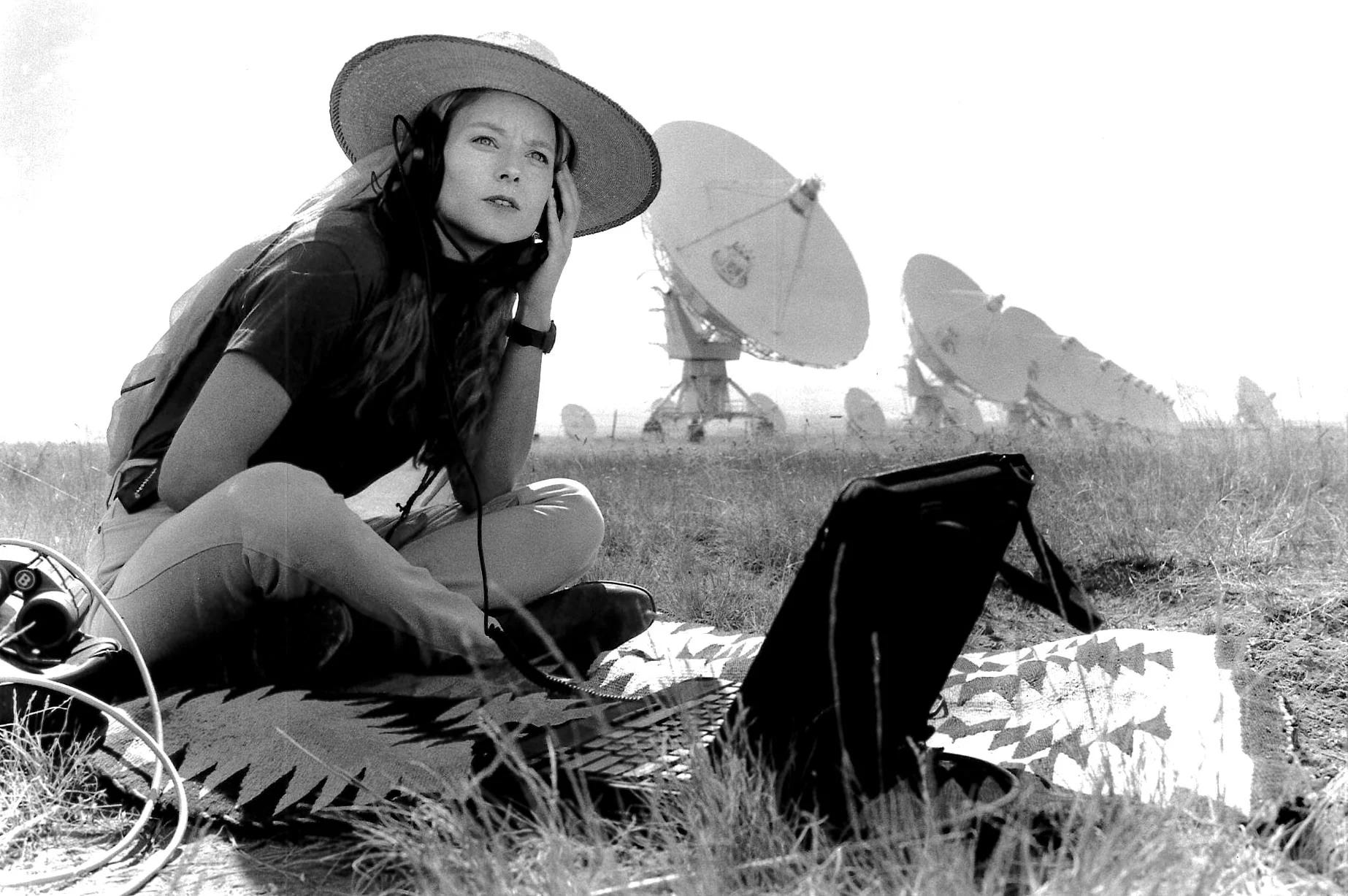
The reader is Jodie Foster in the movie Contact. She’s not waiting for one weird signal; she’s looking for a pattern.
On my first read of A Farewell to Arms, I didn’t read that opening paragraph and say…oh! the leaves falling early that year symbolize early death by war! I’m not that clever.
In the late summer of that year we lived in a house in a village that looked across the river and the plain to the mountains. In the bed of the river there were pebbles and boulders, dry and white in the sun, and the water was clear and swiftly moving and blue in the channels. Troops went by the house and down the road and the dust they raised powdered the leaves of the trees. The trunks of the trees too were dusty and the leaves fell early that year and we saw the troops marching along the road and the dust rising and leaves, stirred by the breeze, falling and the soldiers marching and afterwards the road bare and white except for the leaves.
A Farewell to Arms, Ernest Hemingway
How do we know that’s what Hemingway meant at all? Can’t a thing just be itself? But Hemingway doesn’t ask us to read his mind. He reiterates the meaning, and by the end of the chapter, we know what he’s talking about. The accumulative effect clues us in.
Later in the very brief chapter, he writes:
There was fighting for that mountain too, but it was not successful, and in the fall when the rains came the leaves all fell from the chestnut trees and the branches were bare and the trunks black with rain. The vineyards were thin and bare-branched too and all the country wet and brown and dead with the autumn.
Leaves are falling. Branches are bare. Trunks are black with rain. All the country is wet and brown and dead, and we’re beginning to connect death with all this imagery. Experts rarely quote this passage because he comes right out and says the word dead. Deciphering this part doesn’t feel as clever, but the clues from one passage help us understand the other. Even if we only ever read the chapter once, we’re beginning to feel the meaning in our bones.
And then the chapter ends with this:
At the start of the winter came the permanent rain and with the rain came the cholera. But it was checked and in the end only seven thousand died of it in the army.
He takes all that imagery connected to death and gives it scope. Against the backdrop of war, cholera’s death toll of seven thousand seems small and inconsequential.
What’s more, that imagery is now baked into the novel and can be reflected and repeated elsewhere.
In chapter 2, Hemingway writes:
The forest had been green in the summer when we had come into the town but now there were the stumps and the broken trunks and the ground torn up, and one day at the end of the fall when I was out where the oak forest had been I saw a cloud coming over the mountain. It came very fast and the sun went a dull yellow and then everything was gray and the sky was covered and the cloud came on down the mountain and suddenly we were in it and it was snow. The snow slanted across the wind, the bare ground was covered, the stumps of trees projected, there was snow on the guns and there were paths in the snow going back to the latrines behind trenches.
In chapter 19, Catherine confesses that she fears the rain because sometimes she sees herself dead in it.
In chapter 21, the end of the lovers’ freedom is recognized by the changing of the leaves and, with it, the knowledge that Frederic must return to war.
Life and death is connected to and mirrored in the weather and the seasons. There’s plenty of rain and wet landscapes, and yes, the rain signifies that it’s raining, but the connection of death to rain and bare limbs reminds us that all these descriptions carry the reality of lost lives without Hemingway always having to say so.
Literary analysis fails us as writers because it so often studies these passages in isolation, and we learn the wrong lesson, that meaning is built in isolation when really it is built throughout the body of a work through repetition and reflection.
The author shapes language to carry something beyond its standard weight. We’re all secretly Tolkien, crafting our own invented language, but unlike elvish, the language we create uses our standard diction and carries a surface meaning that is recognizable and meaningful. We are throat singers, hitting two notes at once, our invented language carrying a second harmony beneath the surface.
Some of what we’ve invented is central to the ultimate meaning of the story and to its recontexualization and resolution, but some of that language simply allows the body of our work to say more than the plain meaning of the words we choose.
The six Rs of building meaning are repetition, reflection, recontextualization, reference, relex, and resolution. Relex usually refers to a naive form of language building that simply swaps out words for an existing syntax. If we don’t like that choice of words, we could go with riddle or rune, but I like the idea of an invented language carrying a simple meaning that cuts deep because it’s hidden from the conscious mind. This is the other way that literary analysis misleads us as writers. Sometimes, the greater power is in the meaning a reader feels but can’t articulate. They don’t have to decipher our meaning to feel its impact.
This invented language of ours has power because of the other five R’s. We repeat words and reflect back on previous meanings without direct repetition. We recontextualize an image to give it another meaning: The vineyards were thin and bare-branched too and all the country wet and brown and dead with the autumn.
We reference something outside the text and carry its meaning into our work. That alone doesn’t give the story meaning. Pattern establishes that meaning exists: repetition and reflection. Relex is made up of all the particular meanings we weave through a story, but it doesn’t tell us what the meaning is. Recontextualization, resolution, and reference are ways specific meaning is established.
A tree in winter symbolizing death is not an idea new to Hemingway, nor are falling leaves. He’s not referencing a text but a shared metaphorical language, something akin to Jungian archetypes. We can reference from any shared well of information, but on its own, it won’t be significant to the story and therefore won’t likely to be significant to the reader. Even if you state a meaning outright, it will disappear in the flow of information without a pattern to secure its importance.
Once a pattern is established then you can do interesting things with it. A pattern of trees in winter can suddenly be given new meaning through recontexualization, but for that new context to carry significance, the ideal scenario is a confluence of patterns.
In a small town where a missing man is now presumed dead, a tree remains leafless well into spring when others like it have sprung new life. The missing man planted that tree, and as the town discusses tearing it down, his sister decorates it in protest. The town spares the tree and has a vigil in the missing man’s honor with the sister decorating the site. Meanwhile, her parents are on the verge of divorce, their grief having torn them apart. She decorates the house and holds a memorial, not for her brother, but for her parents’ marriage with a remembrance of the joy they shared across the years. The next day, leaves sprout on the tree thought dead. The sister turns to see her parents, their eyes fixed on the tree, holding one another’s hands. She looks down the road, her heart full of anticipation and a sense of magic.
Repetition establishes a motif of celebration restoring life. Logically, it was coincidental for the tree but instrumental in saving her parents’ marriage. Will celebrating his life bring back her missing brother? I haven’t said, but the pattern establishes the same hope in our hearts as in hers. The death and celebration patterns converge and resolve into a shared recontextualization of new life.
How this story ends will depend on the type of tale we’re writing, but we might realize the site of the vigil is the heart of a dying town. The story of the tree catches the attention of the news and with it, the site of the brother’s vigil. People come to the town to witness the miracle tree and that inflow of visitors gives new life to the town.
And the traveling news reaches a man who’s forgotten who he is. Perhaps not literally. Maybe he simply stopped believing that anyone cared, but the story of the tree carries with it the meaning he had for the people in his town.
And he packs his bags to go home.
— Thaddeus Thomas
The Roles of the Six R’s of Meaning
Establishing patterns that confirm the presence of meaning:
Repetition and Reflection.
A story’s language of meaning:
Relex.
Means by which meaning is established within those patterns, creating that language:
Reference, Recontextualization, and Resolution.
Building Meaning
Part One: Never Let Roald Dahl Stop You from Understanding How Stories Build Meaning
Part Two: The First Four R’s of Story Meaning
Deconstructing the components of literary fiction is interesting, but I'm wondering if writers pay much attention to a check-list how to present meaning to a reader.
My favorite example of "missed meaning" is Hemingway's Hills Like White Elephants. When the instructor said it was about a couple discussing abortion, my first reaction was a dumbfounded , "It is?" What the hell does a white elephant (even if we attribute the meaning of that as a gift one can't afford to maintain and good manners demands it not be returned or sold), have to do with a gal being pregnant? (Unless it means she's gonna get as big as an elephant by the time 9 months passes.)
The "sparse dialog" supposedly contained the symbolism that the reader was to grasp because of the word "operation." To me, it could have been a brain tumor they were discussing. I suppose abortion was no-no topic, if explicit, in Hemingway's day, okay ... but conscious obtuse-ness, even repeated, is still going to leave some readers wondering why they kept reading when it was obvious it makes no sense. (Of course, this makes novel writing sound very esoteric and, by extension, not meant for the hoi polloi.)
In the passages you quoted, I kept thinking of my time in Imperial Valley where the tree leaves don't change color and fall; if a palm tree sheds "leaves', you're likely to get a concussion not think deep thoughts. All the more reason to be specific about the audience you're trying to reach ----the one that shares your frame of references. Hence, the development of niche genres?
But, I do think it makes sense to become aware of the process, techniques and needed to infuse writing that is meaningful, if that's a writer's goal. Looking forward to further discussion!
That was Hemingway’s invention of the iceberg theory, the tame conversation that's really about abortion. One of his big things and I think most heavily employed on screenwriting dialogue these days (and world building).
Funny, until your comment I was to obtuse to understand the title "Hills like White Elephants" refers to an unwanted gift and thus the unwanted child.