

Spoilers for early events in both Superman and Man of Steel.
Passion drives us to learn, and when your passion is writing, good lessons are both hard to come by and overwhelmed by a sea of misinformation. Eager to grow, we’re always learning, even when we what we learn is harmful. The wrong lessons can knock us back, undermine our better sensibilities, and rob our writing of power. When we’re desperate to learn, we’ll take any comment as gospel, even if it wasn’t offered as writing advice, even if it was offered as criticism of a summer popcorn flick.
One critic of Superman (2025) complained he couldn’t feel the tension when our hero fights the kaiju. Bystanders are unafraid and taking pictures. The action focuses on cute rescue scenes instead of the immediate threat. The critic seems to teach us that when the hero is fighting a monster, nothing must undercut the dramatic tension and rob us of the fear that the hero could die at any moment. He says bystanders should always run in terror, and a good writer would cut the nonsense with the dog and the squirrel. Let us feel real jeopardy.
It’s the wrong lesson.
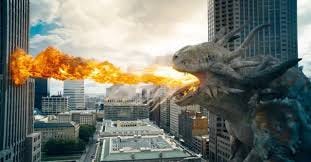
One would certainly expect the lesson to apply in any fight with a giant monster in the heart of the city, but it fails to take into account the story being told. It assumes that there are cookie-cutter purposes that always apply to anything with matching surface vibes.
It would be easy to argue that the scene is world building. After all, the scene reminds us that heroes and monsters are commonplace in Metropolis. The complacency of the bystanders puts them at greater risk, but only because the fully expect Superman to protect them. They’ve been through this before.
That answer isn’t wrong, but it doesn’t explain the necessity of the scene nor the key role it plays in setting up the story’s central conflict.
What’s important here are two story beats juxtaposed against each other. Superman is about to learn, with the rest of the planet, that his intended mission isn’t to help mankind but to rule over it. To make this work, writer/director James Gunn sets up this key story point against the kaiju scene, which emphasizes Superman’s goodness. Superman’s objective is to protect the city and its inhabitants while capturing the monster for an intergalactic zoo or (if absolutely necessary) to euthanize the beast in the most humane way possible. This is set against the other heroes who don’t share this objective, who dispose of the monster cruelly, and who leave it up to Superman to make sure bystanders aren’t killed in the process.
The battle isn’t a story about strength but heart, and that’s important for the story’s central conflict.
If you received the critic’s feedback on the script and rewrote the kaiju scene to emphasize the danger Superman and the city face, you’d undermine the core conflict of your story. Instead of going into the dilemma having demonstrated the goodness of Superman’s heart, you would have emphasized his power, lining up your character with his newly revealed (and evil) mission—not against it.
It’s important that Superman saves the girl, the dog, and the squirrel. Set that within a kaiju fight, and you have something unexpected and fun to watch. Magnify that goal by having Superman want to save the monster, contrast it against heroes who lack that same compassion, and now you’ve helped us understand the character before the central dilemma reveals itself. His unwillingness to be a tyrant isn’t merely something said in a line of dialog. We’ve seen it played out in extreme circumstances.
Interestingly, Man of Steel has a similar scene. This time, Superman (or Clark Kent, rather) finds a Kryptonian scout ship and through a holographic meeting with his father, discovers he’s meant to be a symbol of hope. This revelation is set against a series of non-linear scenes capturing both Clark’s wanderings as an adult, morally confused and uncertain, and his childhood with the Kents who taught him to protect himself by hiding who he truly is. We see Clark struggle against their teaching that he doesn’t owe anyone anything. We see him save people, despite all his earth father taught him, and this reveals his inner sense of hope, set against the conflicting morality of self-preservation.
One gave us an establishing dilemma before the clarity of who his birth parents intended him to be. The other gave us an establishing clarity before the dilemma of his birth parents’ intention. The former rose out of its conflict into a certainty that would drive its version of the man of steel, and the latter dropped its Superman out of certainty and into its central conflict of identity and purpose.
Fans of the character will argue over which represented him best, but that’s not the point here. We have examples of movies that mirror one another in many ways. One man of steel allows himself to be taken prisoner from a newly discovered place of clarity, and his incarceration reveals that he’s no man’s prisoner. The other Superman allows himself to be taken prisoner from a place of newly created internal conflict, and his imprisonment reveals that he’s more at man’s mercy than he ever imagined. Both of these come from contrasting story points with specific purposes, set against contrasting scenes to create the story’s sense of change and movement.
In the case of the kaiju, the purpose was to reveal character so that character could be juxtaposed against his calling. No scene, no matter what its aesthetics, has only one possible purpose. Stories are not cookie cutters.
I’ve used this quote before, but…
Don’t let anyone tell you what a story is, what it needs to include or what form it must take.
—Charlie Kaufman
I’m a fan of story structure because I needed it. As a tool, it helped me deal with my weaknesses as a storyteller, but these days, I’m concerned that structure has become another cookie cutter, limiting the way we tell stories.
I don’t know that I’m right in my concern. My need to follow Kaufman’s advice may be another of my weaknesses. Maybe I’d do better with the cookie-cutter approach, and that doubt doesn’t surprise me. Kaufman himself obviously wrestled with it. The entire movie of Adaptation is based on that struggle.
But I came across an article addressing the strengths and weaknesses of Gunn’s Superman, and all the concerns centered on how the story strayed from what approved story structure was supposed to be. Look, however you approach story, whichever of Adaptation’s Kaufman brothers you identify with, I hope we can all agree that we don’t judge the cookie by the cutter.
Judge a story on its own merits, and that holds true for stories within stories. I don’t expect the kaiju scene in Superman to have the same purpose as any from Godzilla Minus One. We shouldn’t compare our stories’ scenes to vaguely similar scenes in other stories. Instead, we need to understand each scene’s place and purpose within the story and how it contrasts with the scenes juxtaposed against it.
That’s the lesson we should learn.
—Thaddeus Thomas
Excellent!!! Yes!! Great review!
From one reviewer of Superman to another, excellent work! I wanted to talk a bit more on the Kaiju scene in my own but sadly had to let it go, glad to see it get the spotlight in yours!