
This piece is part of “Day of the ___ Writer,” an open collab on the daily experiences behind our writing. Post on your pub about your day, and check out our growing mosaic of many lives.
Day of the Comeback Writer
I don’t write anymore, or at least, I didn’t, not for a few months. Didn’t read either. Depression decided I needed a sabbatical.
My comeback stories are Old Truths for a Best Day and The Gosling, and when it came time to post The Gosling, none of my history as a writer mattered anymore. I couldn’t tell you if it was good or awful, if I’d be welcomed back or laughed out of Substack. The community, however, was supportive, and that helped me write another story.
That I’m writing at all feels like a miracle, and I certainly don’t worry about writing every day. I don’t have a routine, but I am finding my joy again.
What are my days like? I go to bed trying to remember why we can’t travel faster than the speed of light. We can’t because the experienced speed for light is instantaneous, and you can’t travel faster than that without going back in time. As witnessed from the outside, the faster an object travels through space, the slower it travels through time. The witnessed speed of light is C.
It’s vital that I understand these things because I manage a group home for adults with developmental disabilities. The relevance is obvious.
Today is Saturday, and on Saturdays, we visit our daughter. She’s a lawyer in the city. We home-schooled her since before she left Kindergarten because that’s the kind of people we were. I was an evangelical pastor; now I’m a progressive pain-in-the-ass.
Today we visited the museum for the Art in Bloom exhibit that pairs art with flower arrangements. In one small room, the only exhibit is a series of panels that reflect everything in monochrome, and it inspired this piece:
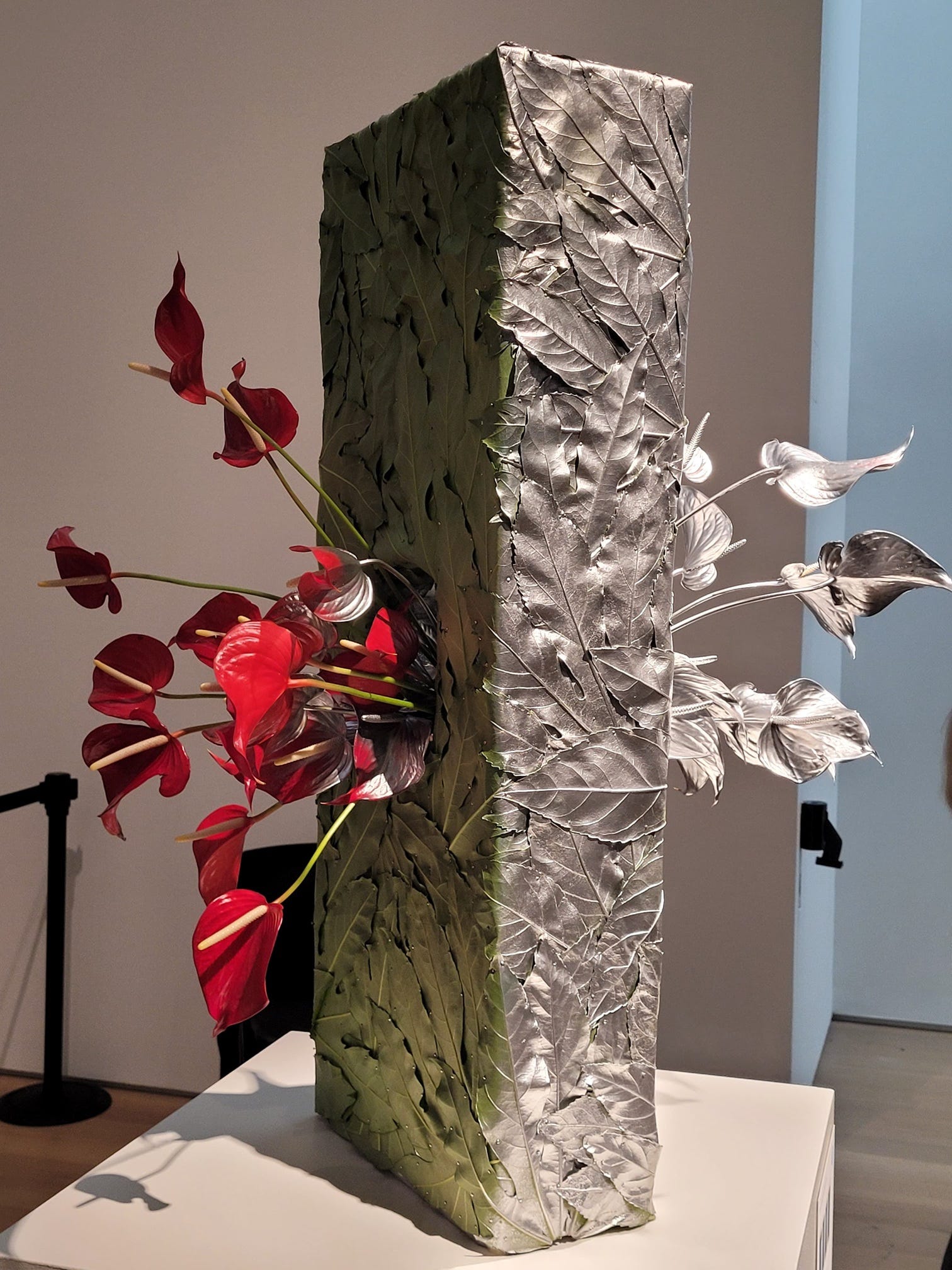
While viewing the remains of ancient sculptures, I was inspired with the title for my next story. With Old Truths, the inspiration was the opening. For Gosling, the story came to me whole, and I just needed to figure out how to make it work.
Intellectually, I believe in writing a bad first draft, but in practice, I usually have to believe where we are and where we’re going, and if I don’t, that’s a problem that can’t be fixed in post. That means I don’t end up with an ugly first draft, and it creates a problem when beta reader feedback suggests you need to fill-out the story more. How do you add to mostly polished piece with a working rhythm without destroying everything?
This time, I solved the dilemma by going through the story and identifying natural pauses in the rhythm. At each of point I placed a marker, allowing me to go back later and consider what (if anything) I wanted to add. It worked remarkably well.
I write at my late father’s desk, in the basement, on a Qwerkywriter keyboard that mimics the look and feel of a typewriter. It’s a first-generation model that I bought used off of Ebay and which was shipped unprotected. It lost a key en route, but I bought a replacement for $5. A few years later, the damage from that rough transit is showing in misbehaving keys. When I replace it, I’ll be buying another, but new this time.
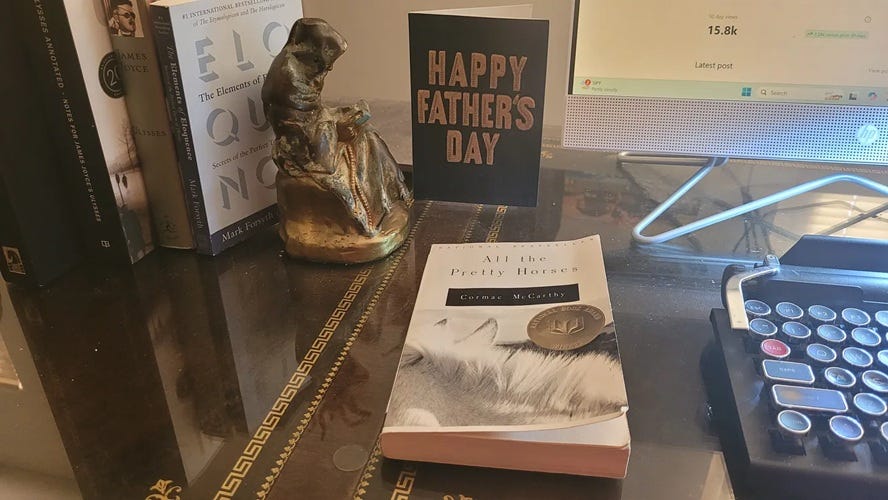
I’m sharing this older picture of the setup so that I don’t have to clean. After lunch, my daughter took us to Subterranean books where I picked up If Beale Street Could Talk by James Baldwin, but if it avoids more chores, a picture of All the Pretty Horses works just as well.
Some of you might notice that the 30-day view count was 15k. At one point, I reached double that. After being gone a few months and publishing two stories and one short essay, I’m currently running close to 2k views a month. To my surprise, the world didn’t end. My subscribers numbers and my paid subscribers have increased. I don’t have to push myself to constantly produce and can, instead, focus on writing the best stories I can.
Take care of yourself. Build a site that will help new readers find what you have to offer, and focus on quality. For me, that means The Literary Salon leads with a hero page that helps direct readers to my essays on prose, but you do what works for you.
Write the way that serves you best.
—Thaddeus Thomas
Welcome back
What a beautiful, vulnerable piece! So real. Thanks for sharing!
"Take care of yourself. Build a site that will help new readers find what you have to offer, and focus on quality"
Yes! Solid advice. Thank you for the reminder.