

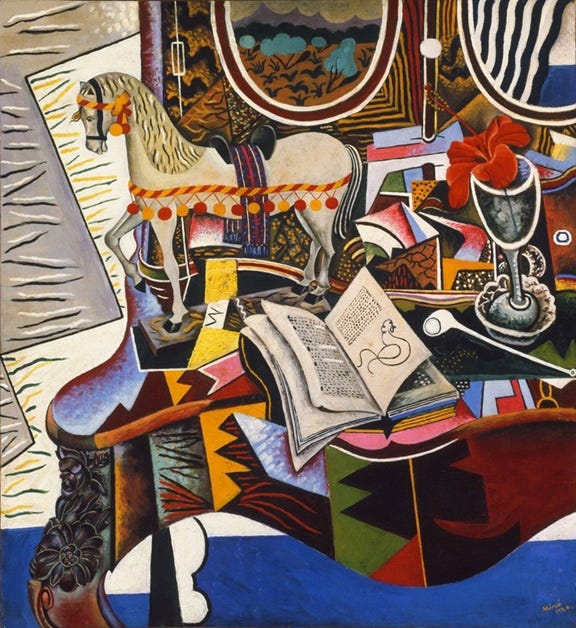
cover image by Joan Miro, 1920
Gripping a reader’s attention focuses on the fundamentals of storytelling over the mechanics of writing. Sentence structure be damned. But when we get our writing out of the way, the story’s hook has a chance to sink, and now we have a reader. The writing matters.
In the opening paragraph, require as little as possible of the reader. Don’t interrupt the flow of your sentences or overload your reader with descriptions or minutiae. Make the paragraph impossible not to read and leave them with a fundamental understanding of the story they’re about to encounter.
We begin by removing interruptions.
Sally, whose eyes twinkled in the moonlight, swung astride her horse…
While it’s perfectly fine sentence construction, by interrupting our subject and verb, we make our reader work. That’s wonderful when the reader is committed to the task, but in the beginning of a story, a thousand distractions vie for her attention. Every mental stumble is an opportunity for her to choose something else.
Sally swung astride her horse and listened for any errant noise. The prairie lay dark and silent, as if listening back…
Challenge every prepositional phrase, not only for its necessity but for its rhythm within the sentence. Every redundancy and every break of rhythm is another opportunity to move on to something else.
Sally swung astride her horse and listened. The prairie lay dark and silent, as if listening back.
Focus now swings into…well…focus.
Before I continue, I can step back and say what I couldn’t earlier. This is one theory. There are many ways to capture your reader, and even if you choose this method, the techniques employed don’t have to be used throughout the entire story. Remember, this is about getting out of your reader’s way until she’s committed to the story.
I saved that statement until now because I wanted to grab your attention and make you interested in what I had to say. Once that was achieved, then I could interrupt myself, slow things down, and offer a little backstory. In the name of fairness, we front-load our articles with caveats, each one of them a reason not to read. We front-load our stories with interruptions and minutiae. To achieve relevance, we require delayed satisfaction from our readers.
But with this present theory, relevance is the focus of the opening. The reader thematically connects with the story and is now eager to read.
Sally swung astride her horse and listened. The prairie lay dark and silent, as if listening back. Time’s face turned away, and a thousand chains let loose their shackles. She could do anything, be anyone. Her father would have no say.
The reader finishes the opening paragraph, and she understands the story. We haven’t yet described Sally, but we know the central dilemma. We reinforce that dilemma when her father calls out and this spiritual reprieve is interrupted.
An alternative opening would begin with father crying out. In such a case, relevance is treated as a mystery for the reader to solve. I once thought it the only way to write.
But with our focus on thematic conflict, the mysteries come later, and the hook is linked to the story’s stakes. The example works if the story continues by introducing her controlling father and perhaps her real-life hope of escape. It doesn’t work the same way if the paragraph is followed by her riding off into the sunrise, leaving her old life behind and ready for adventure. Juxtaposed to such a tale, the opening paragraph becomes backstory.
Our suggested method reveals current conflict, not the origins of present actions. It’s important, because it quickly helps the reader answer the opening’s key question: why am I reading this? An engaged reader knows what she’s reading and why.
The longer it takes a reader to answer that question, the more likely she is to slip away.
— Thaddeus Thomas
Have you read my latest short story?
I feel called out.
very good, well put, only that in serving one kind of reader you can blow your chances with another.